
Free Priority Shipping on USA orders over $150 – 24‑hr processing – Live phone support
$150.00
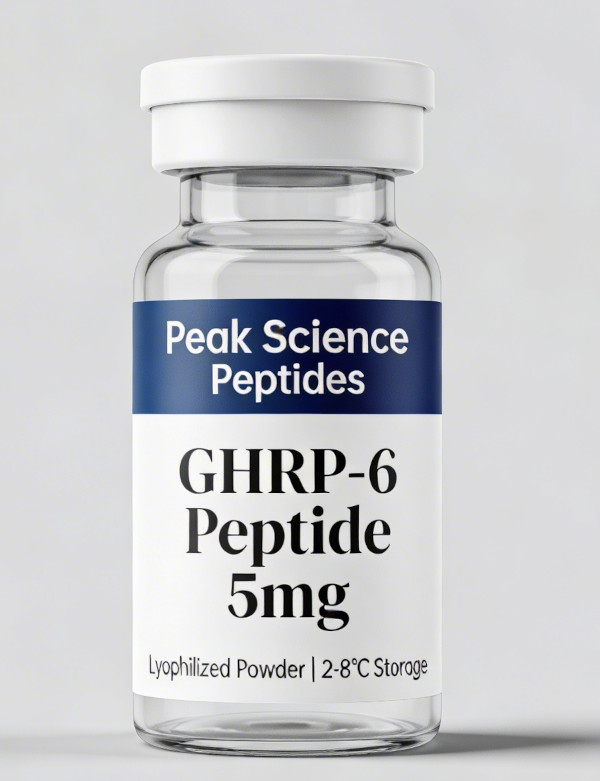
GHRP‑6 (Growth Hormone‑Releasing Peptide‑6) is a synthetic hexapeptide widely investigated for its ability to stimulate endogenous growth hormone release via the ghrelin (GHS‑R) receptor pathway in preclinical and clinical research models. This research peptide has been studied across endocrinology, metabolic science, tissue regeneration, and organ‑protection applications, making it a versatile tool for advanced experimental designs.
At Peak Science Peptides, GHRP‑6 is supplied as a pharmaceutical‑grade lyophilized powder, manufactured under stringent quality controls and verified by independent third‑party laboratory testing for identity, purity, and potency. All GHRP‑6 offered on PeakSciencePeptides.com is intended strictly for in vitro, ex vivo, and in vivo laboratory research in compliant settings and is not approved for human or veterinary use.
What is GHRP‑6 in research?
GHRP‑6 is one of the earliest and most characterized growth hormone secretagogues, originally developed in the 1980s to probe pituitary growth hormone regulation. In experimental systems, it binds the growth hormone secretagogue/ghrelin receptor (GHS‑R1a), promoting pulsatile growth hormone release and downstream insulin‑like growth factor‑1 (IGF‑1) signaling.
Contemporary studies (2023–2025) continue to evaluate GHRP‑6 in models of metabolic dysfunction, ischemia–reperfusion injury, and tissue repair, highlighting its potential role in modulating cellular survival pathways, lipid oxidation, and amino‑acid metabolism. Because of its well‑defined structure and receptor profile, GHRP‑6 remains a reference molecule in growth hormone secretagogue and ghrelin‑axis research.
Key research features of Peak Science Peptides GHRP‑6
Why choose Peak Science Peptides for GHRP‑6?
Peak Science Peptides focuses on research‑grade peptide solutions for laboratories, academic centers, and R&D teams that require consistent quality and documentation. Each GHRP‑6 batch is:
This commitment to verifiable quality enables more reliable data generation in mechanistic, dose‑response, and comparative studies that leverage GHRP‑6 as a ghrelin‑axis tool compound.
In laboratory research, GHRP‑6 is primarily used to investigate growth hormone release and ghrelin‑receptor signaling pathways in pituitary, hypothalamic, and peripheral tissues. Studies demonstrate that it can trigger robust, pulsatile growth hormone responses and modulate downstream metabolic and cell‑survival mechanisms, making it useful for probing endocrine and tissue‑repair biology.
GHRP‑6 itself is not growth hormone; it is a synthetic growth hormone‑releasing peptide (GH secretagogue) that acts upstream by stimulating endogenous GH release via ghrelin receptors. Researchers often employ GHRP‑6 to differentiate receptor‑mediated GH release from direct hormone administration and to model physiological pulsatile secretion.
Recent publications explore GHRP‑6 in several research areas, including metabolic syndrome and insulin resistance, ischemia–reperfusion injury, renal protection, cardiovascular function, and tissue regeneration. These investigations assess how GHRP‑6‑mediated modulation of fatty‑acid oxidation, amino‑acid metabolism, and anti‑apoptotic signaling could influence disease models and recovery processes.
GHRP‑6 is available from specialized research suppliers, such as Peak Science Peptides, for lawful laboratory research under applicable regulations. It is not an approved drug product, and its acquisition and use should comply with local, institutional, and national rules governing research chemicals, including any restrictions related to performance‑enhancing compounds.
No. GHRP‑6 offered by Peak Science Peptides is designated For Research Use Only and is not approved for human or veterinary use, medical treatment, or diagnostic procedures. All handling should be performed by qualified personnel in appropriately equipped laboratory environments, following institutional safety and compliance guidelines.
| Weight | 1 oz |
|---|
Reviews
There are no reviews yet.