
Free Priority Shipping on USA orders over $150 – 24‑hr processing – Live phone support
$500.00
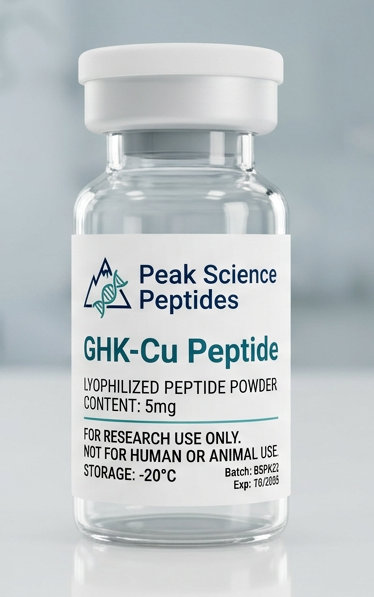
GHK-Cu is a naturally occurring copper-binding tripeptide complex (glycyl-L-histidyl-L-lysine plus Cu²⁺) widely studied for its role in tissue repair, extracellular matrix remodeling, and gene signaling in skin and connective tissues. Research from the 1970s onward indicates that GHK-Cu can modulate thousands of genes associated with inflammation, antioxidant defenses, and regenerative pathways, positioning it as a valuable tool in modern peptide biology.
Investigators have explored its effects on collagen synthesis, angiogenesis, and wound closure kinetics in both in vitro and in vivo models. Recent publications between 2015 and 2025 highlight GHK-Cu as a promising candidate for studying mechanisms of skin rejuvenation, mucosal healing, and cellular stress responses. At Peak Science Peptides, GHK-Cu is supplied as a pharmaceutical-grade research peptide with full third-party laboratory analysis and certificate of analysis (COA) for quality assurance (for research purposes only).
In experimental models, GHK-Cu has been shown to influence core processes such as fibroblast proliferation, collagen and glycosaminoglycan production, and organization of the extracellular matrix. Studies report that this peptide-copper complex can accelerate dermal wound closure, enhance tensile strength of newly formed tissue, and reduce excessive inflammatory signaling. Gene expression analyses suggest that GHK-Cu may “reset” patterns of up to 4,000 human genes toward a profile associated with healthier tissue structure and reduced oxidative stress. Additional research has investigated its impact on angiogenesis, antioxidant enzyme systems, and tight junction proteins in models of mucosal barrier injury. Because of this broad signaling footprint, GHK-Cu is frequently used by researchers examining skin aging, matrix remodeling, and regenerative pharmacology in controlled laboratory settings.
Researchers commonly evaluate GHK-Cu in models that explore skin, connective tissue, and barrier function biology.
All GHK-Cu offered by Peak Science Peptides is intended for laboratory research only and is not manufactured, packaged, or marketed for human or veterinary use.
GHK-Cu is a copper-binding tripeptide complex formed by the peptide GHK (glycyl-L-histidyl-L-lysine) and a divalent copper ion (Cu²⁺). It was first identified in human plasma in the 1970s and later characterized as a biological signaling molecule involved in tissue repair and remodeling. Research indicates that this small complex can interact with cell surface receptors and influence downstream pathways relevant to collagen synthesis, angiogenesis, and inflammatory control. Because of these properties, GHK-Cu has become a widely cited model peptide in regenerative and dermatologic research literature.
In the scientific literature, GHK-Cu is commonly used in cell culture, ex vivo tissue models, and animal studies to examine its impact on wound repair, dermal structure, and gene expression. Investigators often evaluate markers such as collagen and elastin production, glycosaminoglycan content, inflammatory cytokine levels, and antioxidant enzyme activity. Experimental designs may compare GHK-Cu to controls to quantify changes in wound closure rate, tensile strength, or histologic organization of healed tissue. All such applications occur under controlled laboratory conditions in accordance with relevant institutional and regulatory guidelines.
Multiple studies describe GHK-Cu as enhancing dermal wound healing by supporting fibroblast activity, collagen deposition, and angiogenesis. Reports indicate that GHK-Cu can accelerate wound closure and improve the quality of repaired tissue, often with reduced scarring and better-organized collagen fibers compared with untreated controls. Some sources cite 30–50% faster healing in specific models, though outcomes vary depending on the experimental system and formulation used. As with all preclinical findings, results are model-dependent and may not directly translate across species or study designs, so ongoing research continues to refine these observations.
Like many bioactive peptides, GHK-Cu research is influenced by variables such as peptide purity, stability, formulation, concentration, and route of administration within the model. Some publications emphasize that gene-modulatory and regenerative effects can be concentration-dependent, with different outcomes at low versus high exposure levels. Additionally, a substantial portion of the literature involves preclinical or in vitro work, which may not fully predict outcomes in complex human systems. For these reasons, GHK-Cu remains an active area of investigation, and researchers typically interpret results in the context of specific study conditions and controls.
No. GHK-Cu supplied by Peak Science Peptides is designated strictly for laboratory research use and is not intended for human or veterinary administration, medical treatment, or cosmetic application. This designation aligns with the product’s positioning as a tool for in vitro and experimental studies rather than a finished therapeutic or cosmetic good. Each batch is pharmaceutical grade and supported by third-party lab testing and a certificate of analysis to document identity and purity, but it is offered solely to qualified purchasers for controlled research settings. Researchers should follow all applicable regulations, safety guidelines, and institutional protocols when working with this and any other investigational peptide.
Reviews
There are no reviews yet.