
Free Priority Shipping on USA orders over $150 – 24‑hr processing – Live phone support
$600.00
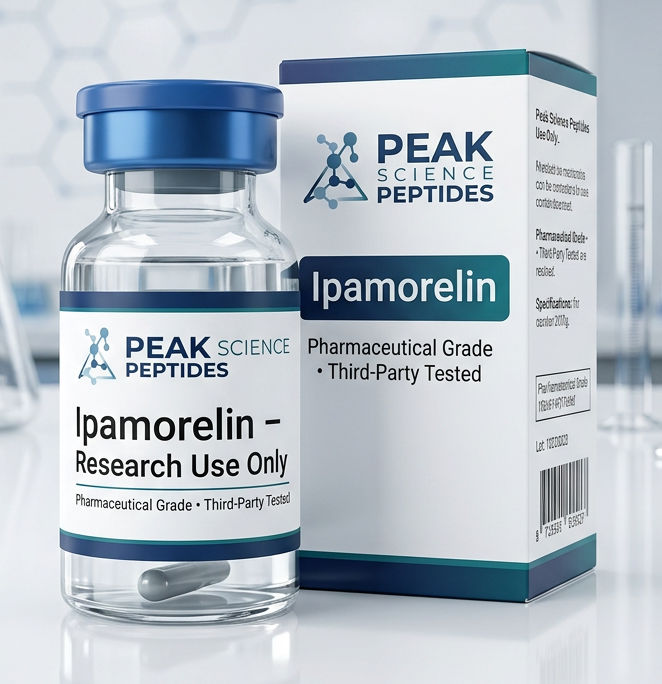
Ipamorelin is a synthetic pentapeptide classified as a selective growth hormone secretagogue (GHS) that targets ghrelin (GHSR-1a) receptors involved in growth hormone regulation pathways. Initially characterized in the late 1990s, Ipamorelin demonstrated potent growth hormone–releasing activity in vitro and in vivo while exhibiting notable selectivity versus earlier secretagogues such as GHRP‑2 and GHRP‑6. Preclinical data indicate that Ipamorelin can stimulate growth hormone release without significantly impacting other pituitary hormones like prolactin or adrenocorticotropic hormone (ACTH), making it a useful model compound for studying GH–IGF‑1 axis signaling.
At Peak Science Peptides, Ipamorelin is supplied as a high‑purity, pharmaceutical‑grade research peptide designed for controlled laboratory and in vitro investigation. Each batch is supported by third‑party analytical testing to verify identity, purity, and consistency, supporting rigorous, reproducible experimental design. This product is intended exclusively for qualified research applications and is not manufactured, packaged, or sold for human or veterinary administration of any kind.
In research settings, Ipamorelin has been shown to act as a selective agonist at the growth hormone secretagogue receptor type 1a (GHSR‑1a), a G‑protein‑coupled receptor expressed in the pituitary and hypothalamus. Receptor activation can initiate intracellular signaling cascades involving cAMP/PKA or phospholipase C pathways, second messenger generation, and calcium mobilization, culminating in enhanced growth hormone secretion from anterior pituitary somatotroph cells. These characteristics allow investigators to probe pulsatile growth hormone dynamics, downstream IGF‑1 production, and energy‑homeostasis signaling with a comparatively selective tool compound.
Ipamorelin is widely used in preclinical and in vitro research exploring growth hormone modulation, metabolic regulation, and tissue remodeling. Typical lines of investigation include GH–IGF‑1 axis characterization, cell proliferation and differentiation models, and studies of receptor selectivity versus legacy secretagogues. Its high receptor specificity and minimal effect on cortisol or ACTH reported in animal and human pharmacology studies make Ipamorelin a valuable reference tool when examining GHSR‑mediated signaling with reduced endocrine confounding.
Researchers also employ Ipamorelin in combination protocols (for example, with CJC‑1295) to study dual‑pathway stimulation of hypothalamic and pituitary signaling and to model physiological growth hormone pulsatility. Such combinations can support experiments focused on circadian hormone patterns, metabolic endpoints, and recovery‑related biomarkers without exogenous growth hormone administration. Across these applications, strict adherence to institutional and regulatory guidelines for peptide handling and laboratory safety is essential.
Ipamorelin is a synthetic pentapeptide (Aib‑His‑D‑2‑Nal‑D‑Phe‑Lys‑NH₂) identified as the first highly selective growth hormone secretagogue targeting the ghrelin (GHSR‑1a) receptor. It has been studied for its ability to stimulate growth hormone release in vitro and in vivo while exerting minimal influence on other pituitary hormones. Because of this selectivity, Ipamorelin is frequently cited in the literature as a model compound for dissecting GH‑specific signaling pathways.
Common research themes include growth hormone pulsatility, IGF‑1 modulation, metabolic regulation, and cellular responses to GHSR‑1a activation. Ipamorelin is also used to compare modern selective secretagogues to older compounds such as GHRP‑2 and GHRP‑6 in preclinical endocrine and metabolic models. In combination protocols, investigators may assess how Ipamorelin interacts with GHRH analogs (e.g., CJC‑1295) to explore dual‑axis stimulation of the GH pathway.
Published data suggest that Ipamorelin displays high selectivity for GHSR‑1a with little to no stimulation of cortisol or ACTH even at comparatively high exposures, unlike some legacy secretagogues. This narrower endocrine footprint can reduce off‑target effects in experimental designs focused on GH and IGF‑1 endpoints. As a result, Ipamorelin is often chosen when researchers need a more selective probe of ghrelin receptor–mediated growth hormone release.
As of the latest published data, Ipamorelin remains primarily a research compound and is not broadly approved as a therapeutic drug by major regulatory agencies. Most clinical and translational interest has focused on characterizing its pharmacology rather than developing it as a widely marketed medication. Peak Science Peptides therefore supplies Ipamorelin exclusively for laboratory and preclinical research in compliance with applicable regulations.
Like all research peptides, Ipamorelin should be handled only by trained personnel in appropriately equipped laboratory environments following institutional safety protocols. Standard good laboratory practice (GLP) includes the use of personal protective equipment, proper storage conditions, and documented chain‑of‑custody for all peptide materials. This product is not formulated, labeled, or intended for human or veterinary administration, and any off‑label or personal use falls outside the scope of its designated research‑only status.
Reviews
There are no reviews yet.